Bitcoin jumps above $74k, maintaining gains as risk sentiment brightens
Bitcoin (BTCUSD) hit a fresh 4-week high of $74,900 early Tuesday morning before giving up some gains, reflecting improved investor risk appetite.
Bitcoin Reaches a Fresh 4-Week High
Bitcoin (BTCUSD) hit a fresh 4-week high of $74,900 early Tuesday morning before giving up some gains, reflecting improved investor risk appetite. Risk sentiment improved after the US and Iran considered resuming peace talks following a recent breakdown in negotiations. Looking ahead, investors should closely monitor geopolitical developments and US-Iran updates, as any escalation in the Middle East could prompt caution. Additionally, the start of the new quarterly earnings season and Federal Reserve speakers’ comments this week will provide insights into the central bank’s rate cut trajectory.
BTCUSD Technical Outlook
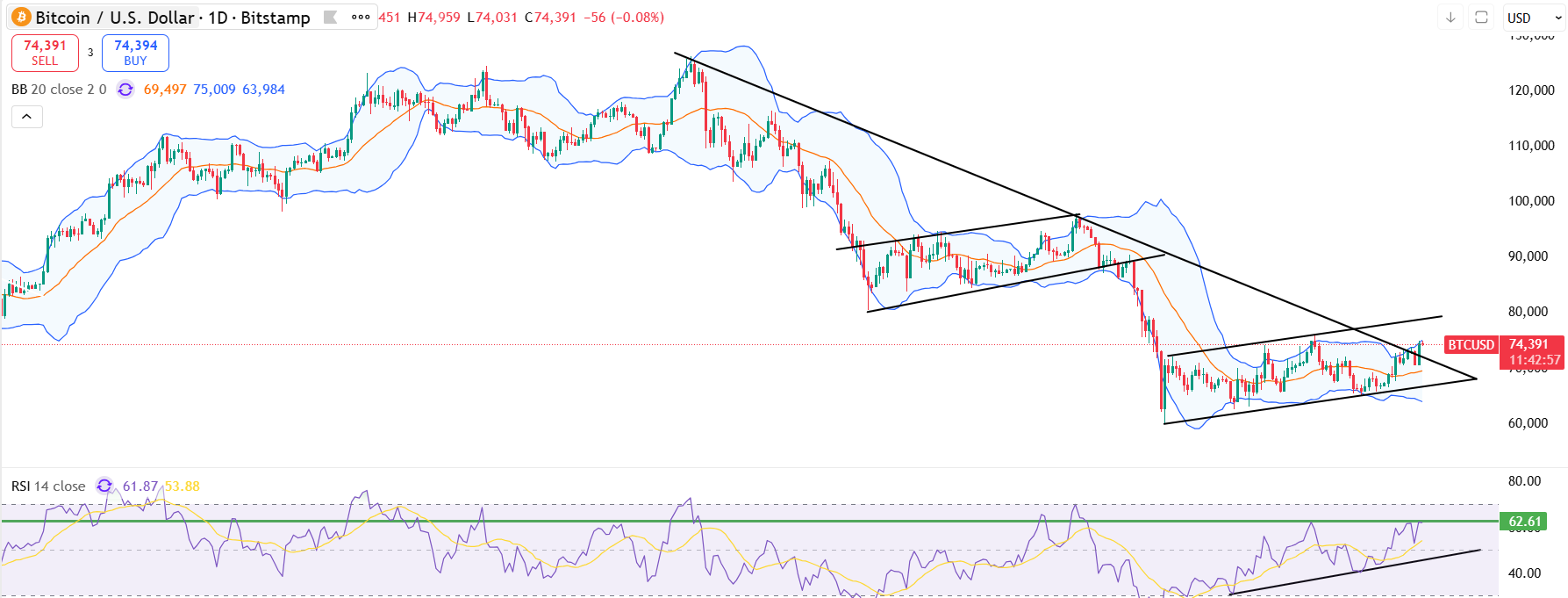
From a technical perspective, Bitcoin is likely to remain strong and stabilize at current levels or move higher. Key resistance lies around $75,800–$76,000, which will be crucial for bulls aiming to reach the next resistance levels at $77,800 and then $79,000. Conversely, a decline toward the $70,000 support level would be important to monitor, as it could signal renewed bearish pressure and challenge the current upward momentum.
Is the Bitcoin Rebound Sustainable?
Since the US-Iran conflict began, cryptocurrencies have emerged as the best-performing risk asset class. BTCUSD is showing early signals of a potential bounce after retesting the $70,000 support zone. The latest fall from $73,600 to $70,000 appears to be a healthy pullback within a broader sideways channel, paving the door for a potential reversal in the coming sessions. However, sharp single-day swings like Monday's bounce necessitate cautious monitoring over the next 2 days. If follow-through buying fails to appear, particularly on higher timeframes, it may signal that the rise was motivated by short-covering or position squaring rather than strong conviction buying.
Warning! This material is not intended as investment advice. Past performance data does not guarantee future returns. Investing in foreign currencies may affect your returns due to their fluctuations. Any transaction in securities may result in both profits and losses. The assumptions and expectations set forth in this material are only estimates that may not be accurate and may change depending on current economic conditions. These statements do not guarantee future returns.
Powiązane artykuły
Paradoks wyboru: dlaczego nadmiar informacji uniemożliwia inwestorom i traderom osiąganie zysków?
W czasach przed pojawieniem się internetu sukces na rynkach finansowych często zależał od dostępu do ekskluzywnych informacji. Dzisiaj sytuacja wygląda zupełnie odwrotnie. Żyjemy w erze nadmiaru informacji, gdzie wiadomości, analizy i wykresy są dostępne 24 godziny na dobę za pomocą zaledwie kilku kliknięć. Pomimo tego nieograniczonego dostępu do danych, zarówno współczesny inwestor, jak i aktywny trader stają przed nowym rodzajem zagrożenia – paraliżem informacyjnym. Umiejętność oddzielenia tego, co istotne, od tego, co nieistotne, staje się ważniejsza niż dogłębna analiza każdego dostępnego fragmentu danych.
Czytaj więcej →Doradcy eksperci: automatyczny handel jako narzędzie, a nie cudowna maszyna
Każdy aktywny inwestor na rynkach finansowych prędzej czy później staje przed pytaniem, czy emocje są rzeczywiście najlepszymi doradcami podczas zawierania transakcji. W środowisku, w którym sekunda wahania lub przypływ strachu może zadecydować o zysku lub stracie, coraz większego znaczenia nabiera pojęcie Expert Advisors (EA). Te algorytmy programowe, zaprojektowane głównie dla platformy MetaTrader, działają jak swego rodzaju „autopilot” na rynkach finansowych. Chociaż kampanie marketingowe często przedstawiają je jako automatyczne maszyny do zarabiania pieniędzy, w rzeczywistości są to złożone narzędzia, których sukces zależy od precyzyjnej konfiguracji i głębokiego zrozumienia związanego z nimi ryzyka.
Czytaj więcej →