Bitcoin jumps above $74k, maintaining gains as risk sentiment brightens
Bitcoin (BTCUSD) hit a fresh 4-week high of $74,900 early Tuesday morning before giving up some gains, reflecting improved investor risk appetite.
Bitcoin Reaches a Fresh 4-Week High
Bitcoin (BTCUSD) hit a fresh 4-week high of $74,900 early Tuesday morning before giving up some gains, reflecting improved investor risk appetite. Risk sentiment improved after the US and Iran considered resuming peace talks following a recent breakdown in negotiations. Looking ahead, investors should closely monitor geopolitical developments and US-Iran updates, as any escalation in the Middle East could prompt caution. Additionally, the start of the new quarterly earnings season and Federal Reserve speakers’ comments this week will provide insights into the central bank’s rate cut trajectory.
BTCUSD Technical Outlook
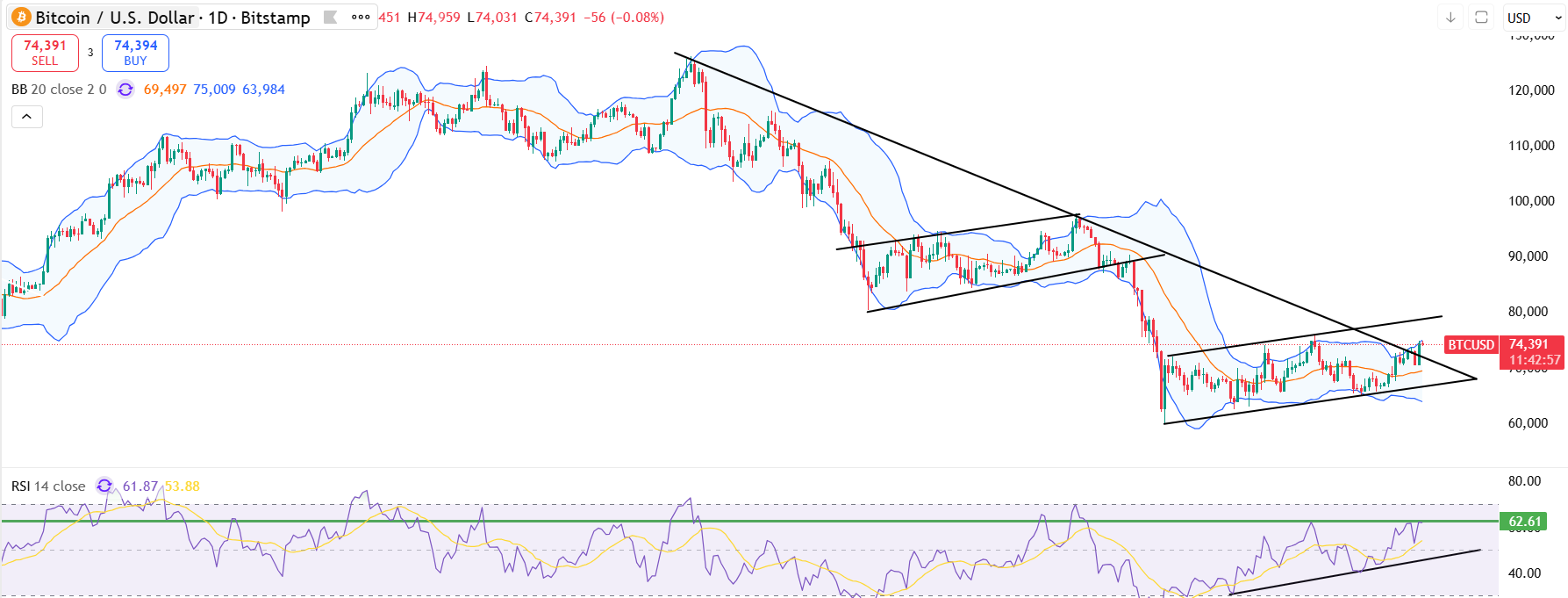
From a technical perspective, Bitcoin is likely to remain strong and stabilize at current levels or move higher. Key resistance lies around $75,800–$76,000, which will be crucial for bulls aiming to reach the next resistance levels at $77,800 and then $79,000. Conversely, a decline toward the $70,000 support level would be important to monitor, as it could signal renewed bearish pressure and challenge the current upward momentum.
Is the Bitcoin Rebound Sustainable?
Since the US-Iran conflict began, cryptocurrencies have emerged as the best-performing risk asset class. BTCUSD is showing early signals of a potential bounce after retesting the $70,000 support zone. The latest fall from $73,600 to $70,000 appears to be a healthy pullback within a broader sideways channel, paving the door for a potential reversal in the coming sessions. However, sharp single-day swings like Monday's bounce necessitate cautious monitoring over the next 2 days. If follow-through buying fails to appear, particularly on higher timeframes, it may signal that the rise was motivated by short-covering or position squaring rather than strong conviction buying.
Warning! This material is not intended as investment advice. Past performance data does not guarantee future returns. Investing in foreign currencies may affect your returns due to their fluctuations. Any transaction in securities may result in both profits and losses. The assumptions and expectations set forth in this material are only estimates that may not be accurate and may change depending on current economic conditions. These statements do not guarantee future returns.
Articles connexes
Le paradoxe du choix : pourquoi un excès d'informations empêche-t-il les investisseurs et les traders de réaliser des bénéfices ?
Avant l'avènement d'Internet, la réussite sur les marchés financiers dépendait souvent de l'accès à des informations exclusives. Aujourd'hui, c'est tout le contraire. Nous vivons à l'ère de la surabondance d'informations, où les actualités, les analyses et les graphiques sont disponibles 24 heures sur 24 en quelques clics. Malgré cet accès illimité aux données, l'investisseur moderne ainsi que le trader actif sont confrontés à un nouveau type de menace : la paralysie de l'information. La capacité à distinguer l'essentiel du superflu devient une compétence plus importante que l'analyse approfondie de chaque donnée disponible.
En savoir plus →Les Expert Advisors : le trading automatisé, un outil et non une machine miracle
Tout investisseur actif sur les marchés financiers finit par se demander si ses émotions sont vraiment les meilleurs conseillers lorsqu'il négocie. Dans un environnement où une seconde d'hésitation ou un élan de peur peut faire la différence entre profit et perte, le terme « Expert Advisors » (EA) prend de plus en plus d'importance. Ces algorithmes logiciels, conçus principalement pour la plateforme MetaTrader, agissent comme une sorte de « pilote automatique » sur les marchés financiers. Bien que les campagnes marketing les présentent souvent comme des machines à gagner de l'argent automatiquement, il s'agit en réalité d'outils complexes dont le succès dépend d'une configuration précise et d'une compréhension approfondie des risques associés.
En savoir plus →