Bitcoin jumps above $74k, maintaining gains as risk sentiment brightens
Bitcoin (BTCUSD) hit a fresh 4-week high of $74,900 early Tuesday morning before giving up some gains, reflecting improved investor risk appetite.
Bitcoin Reaches a Fresh 4-Week High
Bitcoin (BTCUSD) hit a fresh 4-week high of $74,900 early Tuesday morning before giving up some gains, reflecting improved investor risk appetite. Risk sentiment improved after the US and Iran considered resuming peace talks following a recent breakdown in negotiations. Looking ahead, investors should closely monitor geopolitical developments and US-Iran updates, as any escalation in the Middle East could prompt caution. Additionally, the start of the new quarterly earnings season and Federal Reserve speakers’ comments this week will provide insights into the central bank’s rate cut trajectory.
BTCUSD Technical Outlook
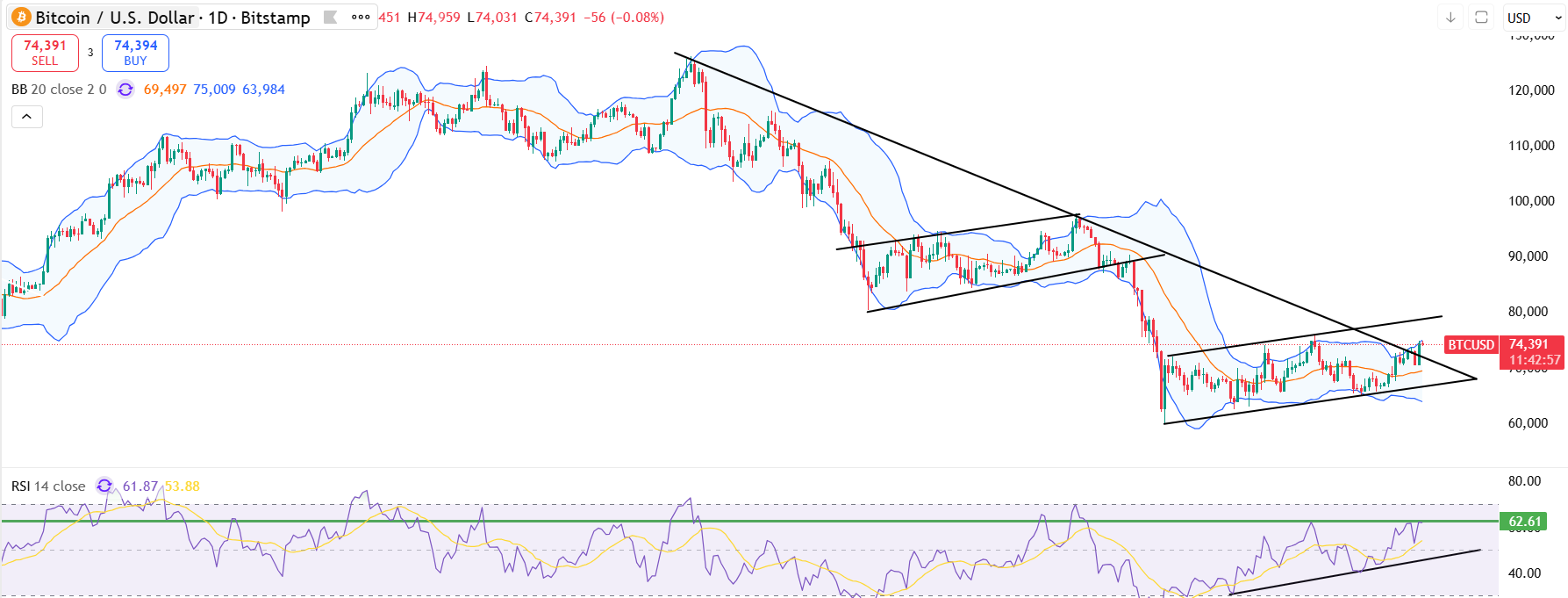
From a technical perspective, Bitcoin is likely to remain strong and stabilize at current levels or move higher. Key resistance lies around $75,800–$76,000, which will be crucial for bulls aiming to reach the next resistance levels at $77,800 and then $79,000. Conversely, a decline toward the $70,000 support level would be important to monitor, as it could signal renewed bearish pressure and challenge the current upward momentum.
Is the Bitcoin Rebound Sustainable?
Since the US-Iran conflict began, cryptocurrencies have emerged as the best-performing risk asset class. BTCUSD is showing early signals of a potential bounce after retesting the $70,000 support zone. The latest fall from $73,600 to $70,000 appears to be a healthy pullback within a broader sideways channel, paving the door for a potential reversal in the coming sessions. However, sharp single-day swings like Monday's bounce necessitate cautious monitoring over the next 2 days. If follow-through buying fails to appear, particularly on higher timeframes, it may signal that the rise was motivated by short-covering or position squaring rather than strong conviction buying.
Warning! This material is not intended as investment advice. Past performance data does not guarantee future returns. Investing in foreign currencies may affect your returns due to their fluctuations. Any transaction in securities may result in both profits and losses. The assumptions and expectations set forth in this material are only estimates that may not be accurate and may change depending on current economic conditions. These statements do not guarantee future returns.
Articoli correlati
Il paradosso della scelta: perché un eccesso di informazioni impedisce agli investitori e ai trader di realizzare profitti?
Nell'era pre-Internet, il successo sui mercati finanziari dipendeva spesso dall'accesso a informazioni esclusive. Oggi la situazione è esattamente l'opposto. Viviamo in un'epoca di sovraccarico di informazioni, in cui notizie, analisi e grafici sono disponibili 24 ore su 24 con pochi clic. Nonostante questo accesso illimitato ai dati, tuttavia, sia l'investitore moderno che il trader attivo devono affrontare un nuovo tipo di minaccia: la paralisi informativa. La capacità di filtrare l'essenziale dall'irrilevante sta diventando una competenza più importante dell'analisi approfondita di ogni singolo dato disponibile.
Leggi di più →Expert Advisors: il trading automatizzato come strumento, non come una macchina miracolosa
Ogni investitore attivo sui mercati finanziari si trova prima o poi a chiedersi se le proprie emozioni siano davvero i migliori consiglieri quando si fa trading. In un contesto in cui un secondo di esitazione o un impeto di paura possono fare la differenza tra profitto e perdita, il termine Expert Advisors (EA) sta assumendo sempre più importanza. Questi algoritmi software, progettati principalmente per la piattaforma MetaTrader, fungono da una sorta di "pilota automatico" per i mercati finanziari. Sebbene le campagne di marketing li presentino spesso come macchine automatiche per fare soldi, in realtà sono strumenti complessi il cui successo dipende da una configurazione precisa e da una profonda comprensione dei rischi associati.
Leggi di più →