Bitcoin jumps above $74k, maintaining gains as risk sentiment brightens
Bitcoin (BTCUSD) hit a fresh 4-week high of $74,900 early Tuesday morning before giving up some gains, reflecting improved investor risk appetite.
Bitcoin Reaches a Fresh 4-Week High
Bitcoin (BTCUSD) hit a fresh 4-week high of $74,900 early Tuesday morning before giving up some gains, reflecting improved investor risk appetite. Risk sentiment improved after the US and Iran considered resuming peace talks following a recent breakdown in negotiations. Looking ahead, investors should closely monitor geopolitical developments and US-Iran updates, as any escalation in the Middle East could prompt caution. Additionally, the start of the new quarterly earnings season and Federal Reserve speakers’ comments this week will provide insights into the central bank’s rate cut trajectory.
BTCUSD Technical Outlook
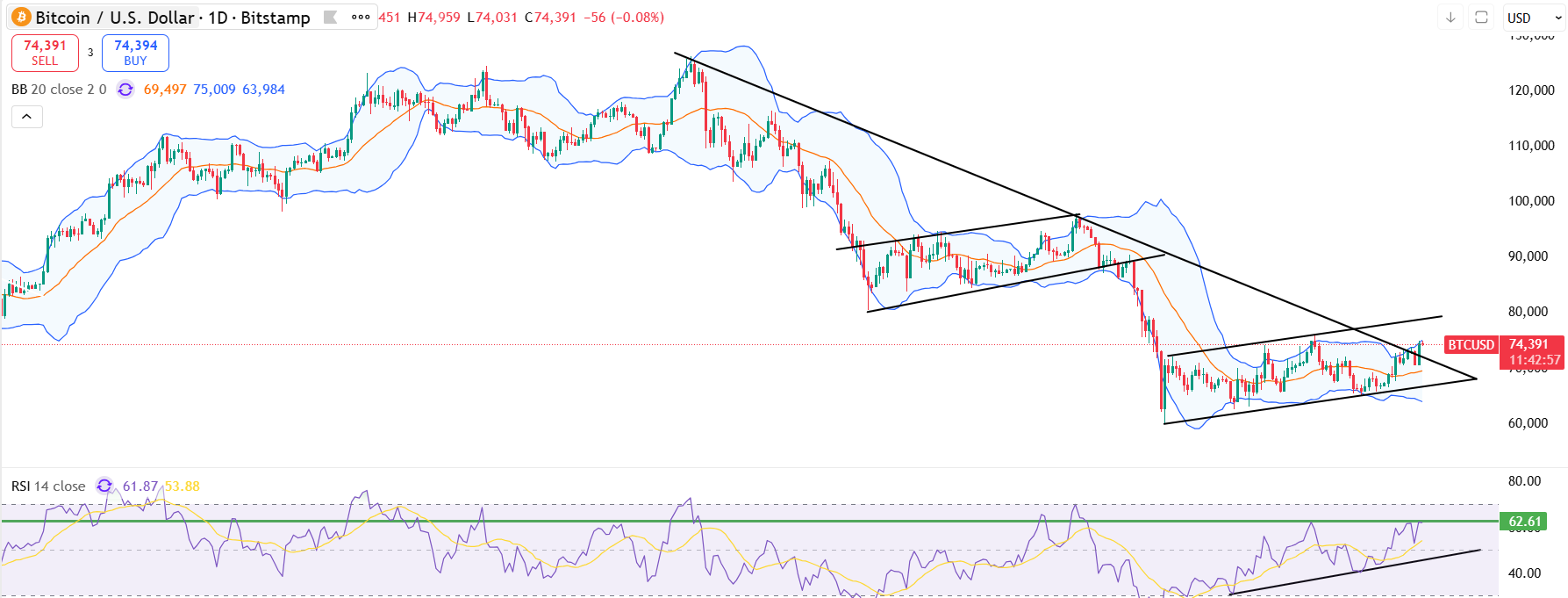
From a technical perspective, Bitcoin is likely to remain strong and stabilize at current levels or move higher. Key resistance lies around $75,800–$76,000, which will be crucial for bulls aiming to reach the next resistance levels at $77,800 and then $79,000. Conversely, a decline toward the $70,000 support level would be important to monitor, as it could signal renewed bearish pressure and challenge the current upward momentum.
Is the Bitcoin Rebound Sustainable?
Since the US-Iran conflict began, cryptocurrencies have emerged as the best-performing risk asset class. BTCUSD is showing early signals of a potential bounce after retesting the $70,000 support zone. The latest fall from $73,600 to $70,000 appears to be a healthy pullback within a broader sideways channel, paving the door for a potential reversal in the coming sessions. However, sharp single-day swings like Monday's bounce necessitate cautious monitoring over the next 2 days. If follow-through buying fails to appear, particularly on higher timeframes, it may signal that the rise was motivated by short-covering or position squaring rather than strong conviction buying.
Warning! This material is not intended as investment advice. Past performance data does not guarantee future returns. Investing in foreign currencies may affect your returns due to their fluctuations. Any transaction in securities may result in both profits and losses. The assumptions and expectations set forth in this material are only estimates that may not be accurate and may change depending on current economic conditions. These statements do not guarantee future returns.
Artículos relacionados
La paradoja de la elección: ¿Por qué el exceso de información impide a los inversores y operadores obtener beneficios?
En la era anterior a Internet, el éxito en los mercados financieros solía depender del acceso a información exclusiva. Hoy en día, la situación es todo lo contrario. Vivimos en una era de sobrecarga de información, en la que las noticias, los análisis y los gráficos están disponibles las 24 horas del día con solo unos pocos clics. Sin embargo, a pesar de este acceso ilimitado a los datos, tanto el inversor moderno como el operador activo se enfrentan a un nuevo tipo de amenaza: la parálisis informativa. La capacidad de filtrar lo esencial de lo irrelevante se está convirtiendo en una habilidad más importante que el análisis en profundidad de cada dato disponible en sí mismo.
Leer más →Asesores expertos: el trading automatizado como herramienta, no como una máquina milagrosa
Todo inversor activo en los mercados financieros se enfrenta tarde o temprano a la pregunta de si sus emociones son realmente los mejores consejeros a la hora de operar. En un entorno en el que un segundo de vacilación o un repunte de miedo pueden marcar la diferencia entre ganancias y pérdidas, el término «Expert Advisors» (EA) está cobrando cada vez más protagonismo. Estos algoritmos de software, diseñados principalmente para la plataforma MetaTrader, actúan como una especie de «piloto automático» para los mercados financieros. Aunque las campañas de marketing suelen presentarlos como máquinas automáticas de hacer dinero, en realidad son herramientas complejas cuyo éxito depende de una configuración precisa y de un profundo conocimiento de los riesgos asociados.
Leer más →